The Risk Manager
One rule book over every account — daily loss and profit limits, session blocks, blocked instruments and a cooldown — that cannot be loosened once it starts hurting.
The Risk Manager is one set of rules over every account, live and simulator alike, set from the Command Center’s Risk menu. The Risk chip in the Command Center’s frame reads watching, cooldown or off; click it for the rule book and today’s numbers.
The rules
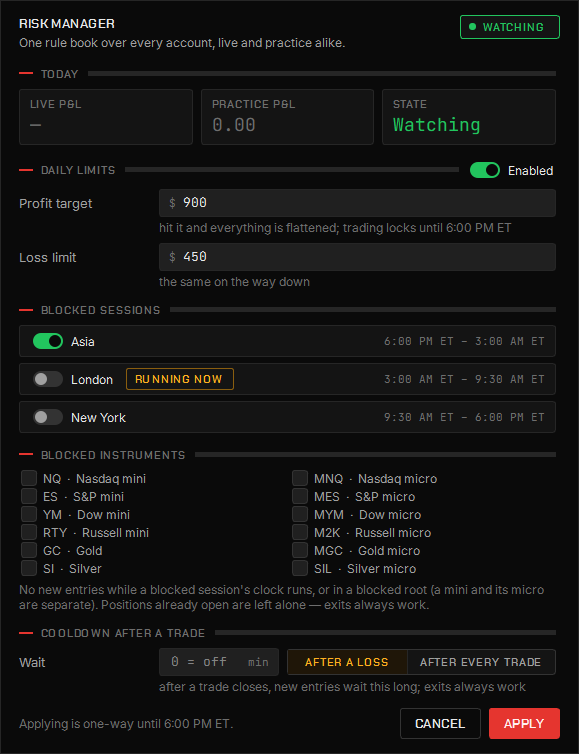
| Rule | What it does |
|---|---|
| Daily loss limit | In dollars. Hitting it closes every position, cancels working orders and blocks new entries until the next session open at 18:00 ET. |
| Daily profit target | The same, on the way up — a day that has made its number is over. |
| Session blocks | Refuse new entries during the Asia, London or New York hours you choose. |
| Blocked instruments | Refuse new entries on any of the twelve contracts — NQ, ES, YM, RTY, GC, SI and their micros — outright. Each is its own switch, so blocking NQ leaves an MNQ ticket alone. |
| Cooldown | Refuse new entries for a set number of minutes after a losing trade, or after every trade, counted from the fill that closed it. Nothing is flattened and resting orders are left where they are. |
Applying is one-way
Once applied, the rules are frozen until the next trade window. A limit cannot be raised after it starts hurting. That is the point.
Set the limits before the session, not during it.
What a lockout does and does not do
- New entries are refused on the ticket, the chart, the ladder, the copier’s followers and the Auto Trader. The ticket’s entry buttons grey; the ladder paints a banner.
- Orders that close or reduce a position always go through. FLAT and FLATTEN keep working. A lockout never traps the position it fired on.
- The lockout clears at the next session open, 18:00 ET.
Per-account rules
The Risk Manager sits above the accounts. A simulated account can carry its own funded-program rule book — drawdown, daily loss on equity or realised, profit target, consistency, contract caps — that locks or fails the account the way the program would. See Accounts & the simulator. The copier and the Auto Trader add per-follower and per-deployment risk books on top, and all of them follow the same principle: a lock blocks entries only; exits always run.