A sum is not a description
A conventional ladder prints one number per price. At 20,142.00 on NQ it says 480, and 480 is true. It is also almost the only fact about that level that cannot distinguish it from a completely different level.
Two books produce the same 480. In the first, one participant is resting 310 contracts and a handful of smaller orders sit behind it. In the second, roughly forty orders in the low teens are standing side by side and none of them is bigger than 38. Same price, same total, same row on the screen.
They are not the same level. They can be dismantled in different ways, at different speeds, by different numbers of people, and the ending each one produces looks different on a chart. A market-by-order feed carries the individual resting orders rather than one aggregate per price, which is what lets the Advanced DOM ladder print the largest single order beside the level total. Written the way the ladder writes it, those two levels read 310 × 480 and 38 × 480.
The second number is the sum. The first is the part the sum threw away.
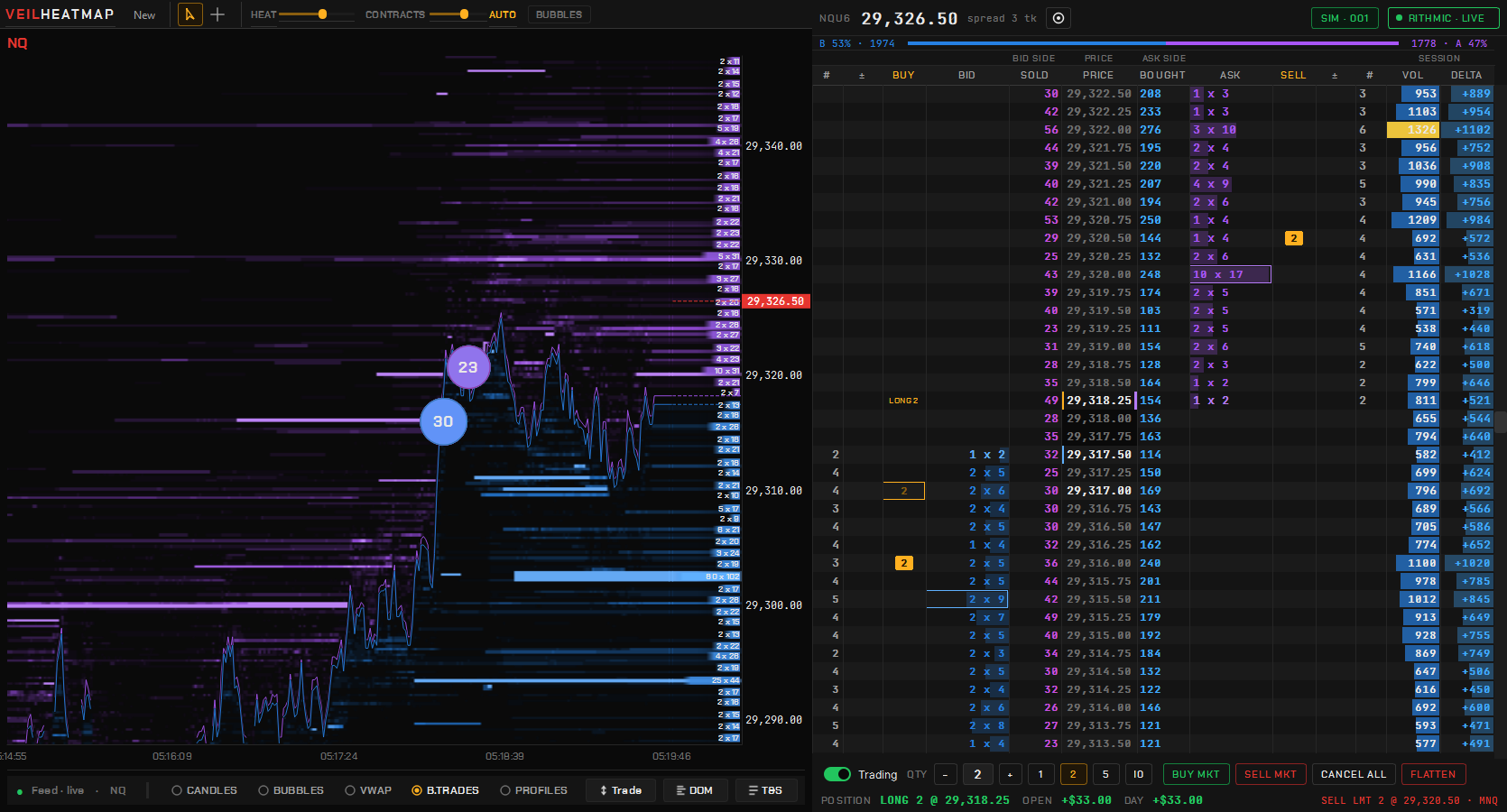
Which half moved
Once a level carries two numbers instead of one, it can change in ways a single number cannot report. That is the practical use, and it takes about a second to read.
Start with 310 × 480 and watch the pair over the next few snapshots.
If it goes to 310 × 395, the total fell by 85 and the largest order did not move. The small company around the anchor thinned out. Whoever is resting 310 contracts is still resting 310 contracts, and has watched 85 contracts of other size leave without joining them.
If instead it goes to 42 × 470, almost nothing happened to the total — 480 to 470 — while the largest single order fell from 310 to 42. The anchor left, and a crowd arrived in the same seconds to replace nearly all of the size it took with it. An aggregate ladder shows that as 480 becoming 470 and reports, in effect, that nothing happened.
Those two are opposite events. In the first the level got structurally simpler and the biggest commitment stayed. In the second the biggest commitment went and the level is now held up by forty separate small decisions. A sum that barely moves is not evidence that a level is unchanged. It is only evidence that the arithmetic came out the same.
The concentration is worth reading as a fraction, because it travels between prices and between sessions. 310 of 480 is 65% of the level in one order. 38 of 480 is 8%. A level in the sixties is one participant plus decoration. A level in single digits is a crowd, and a crowd has no single point of failure.
What forty orders cannot do quickly
The reason concentration matters at all is that resting size leaves in units of decisions, not contracts.
A 310-contract order can be gone between one snapshot and the next. One participant, one cancellation, and 65% of the level is no longer there. That is why a heavily concentrated wall so often ends in a clean vertical edge on the liquidity heatmap rather than fading: there was never anything gradual available to it.
Forty orders averaging twelve contracts each cannot do that. Even if every one of those participants decides to withdraw within the same few seconds, they decide separately, at slightly different moments, having noticed slightly different things. The level thins across several snapshots. It is retreating just as surely, and it looks nothing like the first case while it does.
So the split changes what a shape ought to mean to you. A vertical edge under a level that was reading 8% concentration is genuinely odd — forty participants rarely act as one. A vertical edge under a level reading 65% is the ordinary way that kind of level ends, and it should surprise you far less than it does the first few times you see it.
The same asymmetry runs the other way. When a 38 × 480 level holds through 1,200 contracts of aggression, that is forty participants each choosing, repeatedly, not to step back. When a 310 × 480 level holds through the same 1,200, it is largely one participant's inventory being tested. Both hold. Only one of them required a consensus.
What it costs to read the sum instead
The error here is not abstract, and it has a price you can write down.
Say you lean on an ask level reading 480 on NQ, size four contracts, expecting it to cap the move. What you did not see is that it was 350 × 480: one order carrying nearly three-quarters of the defence. It is cancelled on approach, and price runs ten ticks past where you expected to be stopped before you are flat. NQ is $5 a tick, so ten ticks on four contracts is $200. The level did nothing unusual. You read a number that had been arranged, by summation, to hide the only fact that mattered.
The mirror error is quieter. You see a level thin from 480 to 300 and step aside, when what actually happened was that the small orders left and the 310-contract anchor never moved. There is no receipt for exiting a position that would have worked. It shows up in a journal as a scratch, and scratches are the errors that survive review longest, because nothing about them stings.
Neither of those is a rule about when to trade. They are both the same observation: a total is a lossy summary, and the loss is not random. It falls hardest on exactly the structural fact — how many participants stand behind this price — that decides how the level can end.
What the split does not tell you
It does not tell you who anyone is. A 310-contract resting order is one order. It is not proof of an institution, a professional, or anything else about the account behind it, and no feed carries a field that says. Size is size.
It does not tell you intent either. A large resting order may be genuine liquidity, a hedge that gets re-priced the moment the underlying moves, one leg of something whose other legs are elsewhere, or size that was never going to trade. Cancelling it is ordinary, legal behaviour in an electronic book, and the glossary is deliberately careful about that distinction.
It does not tell you about the orders you cannot see. The ladder shows the visible book as your Level 2 feed carries it. Iceberg and reserve orders display a fraction of themselves by design, and a level reading 12 × 300 may be defended by considerably more than 300 contracts. The concentration reading is a reading of what is shown, not of what exists.
And it does not tell you direction. Knowing that a level is one order rather than forty describes how that level can leave. It says nothing about where price goes next, whether the level matters to the session at all, or whether any of it is worth a trade. The help centre covers how each panel is read, and the risk disclosure states the rest plainly: order-flow tools describe the market, they do not forecast it, and no reading of them makes a losing trade less possible.
Newsletter
Get updates, offers and events
New features, launch offers and live sessions, straight to your inbox. Unsubscribe any time.